Cheapest Sora 2 API Access in 2025: GrsAI at $0.08/Video – High Stability, No Failure Fees (Hands-On Experience)
The Sora2 model official API is now officially open, which is undoubtedly a huge business opportunity for enterprises — just a few lines of code can integrate film-level content production capabilities into your own applications, products, and workflows.
Standard version (sora-2, 720p): $0.10/second ($7 for a 10s video, $11 for a 15s video)
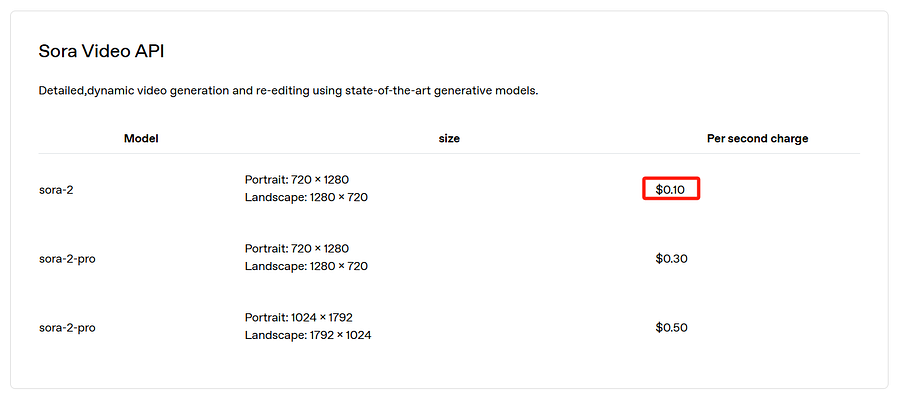
The official per-second billing is ridiculously expensive! For product prototypes that require frequent iteration testing, or e-commerce scenarios planning to batch-generate videos for thousands of products, the accumulated costs will be astronomical. How many enterprises can afford to call it? So everyone prefers to look for API aggregation platforms, using the same model at prices cheaper than official.
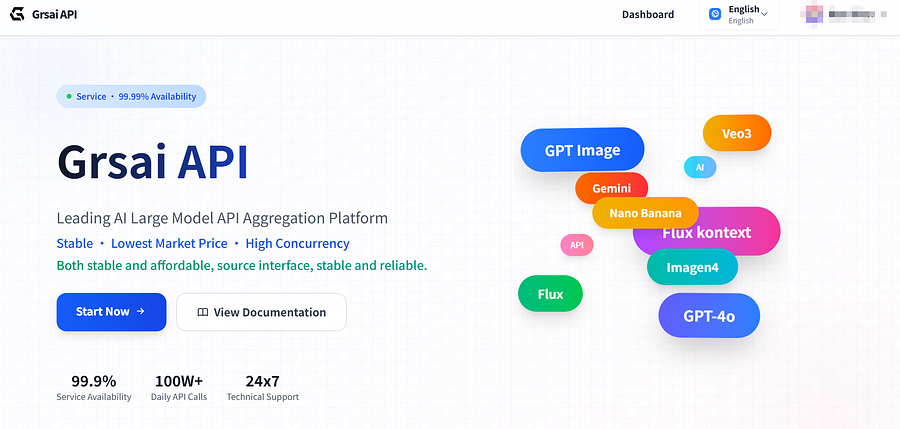
For the vast number of small and medium-sized enterprises and independent developers, where can you find a Sora2 API site with prices as low as “cabbage price”! No deduction for failed calls! Supports high concurrency and guarantees stability?

This article will conduct a multi-dimensional in-depth evaluation of GrsAi API AI large model API aggregation platform, which is a source supplier, not a third-party relay. It has recently gained a lot of attention in the overseas circle, with website visits surging from 9.5K to 91.32K in just two months, and monthly visits approaching 100,000. How is its model stability? Why has it attracted so many developers? I will evaluate it around several core indicators that developers care about most, to see if the $0.08/video price can withstand your demand volume.
I. Comparison of Core Functions of Popular API Platforms
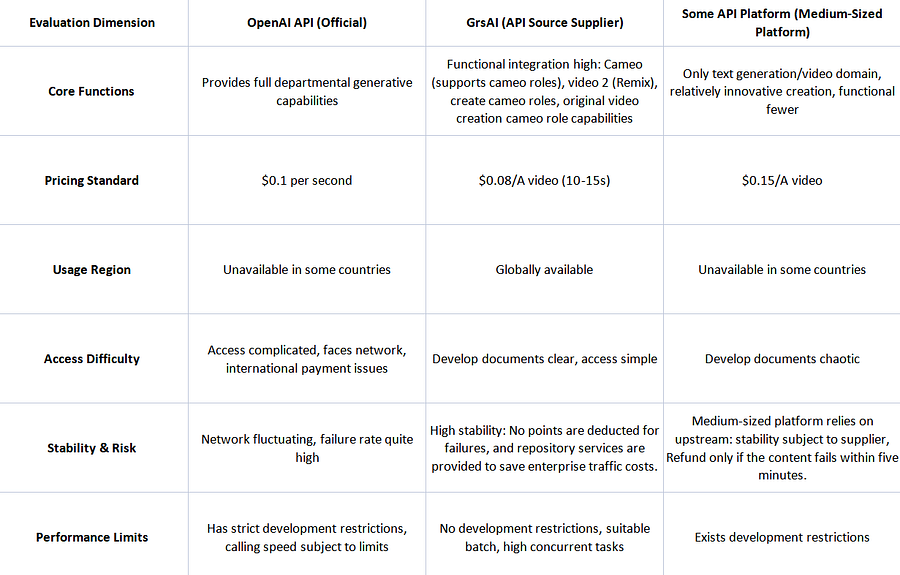
II. In-Depth Testing of GrsAI Stability and Cost-Effectiveness
To verify GrsAI’s performance in actual production environments, we designed a one-week stress and cost test, mainly focusing on five core dimensions: billing mode, service stability, personalized service, functional completeness, and global availability.
Billing Mode:
Official Sora2 API 10s video about $7, while GrsAI Sora2 only $0.08. This means costs are reduced by over 98%. For projects requiring large-scale or frequent calls, this is a decisive price advantage.
Current models on the site include: Nano Banana Pro-$0.09/image, Nano Banana-$0.022/image, Sora-image (Gpt4o)-$0.02/image, Sora2 — — $0.08/video, Veo3.1/Veo3.0-$0.4/image, Gemini……. For more, please check the GrsAi (https://grsai.com/dashboard/models)console model list.
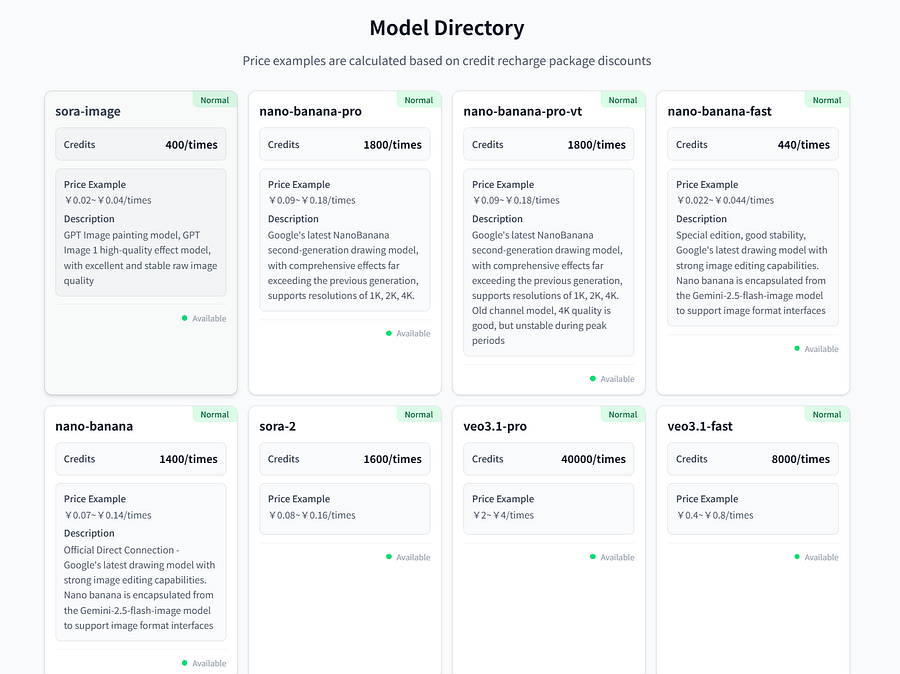
And GrsAI platform adopts a “no deduction for failures” mechanism. We simulated 20 calls including violating content or wrong parameters. Results showed that all failed calls were automatically refunded within seconds, reducing trial-and-error costs to zero.
Stability and Failure Rate:
Service stability directly determines whether it can be put into production. We conducted extreme stress tests on “high concurrency” and “high stability”.
- High Concurrency Limit Test: We initiated 500 concurrent requests within one minute, simulating instantaneous traffic peaks. Test results showed that all 500 requests were successfully received and entered the processing queue, no service refusals or crashes, system response stable, average generation speed 3 minutes.
- Large-Scale Stability Test: To test sustained service capability, we conducted over 3000 standard video generation calls at different times of the day.
Final success rate as high as 99.1%. For the very few failure cases (about 0.9%), root cause analysis showed all failures were clearly attributable to client input issues, such as prompts unintentionally triggering the platform’s strict content safety red lines (e.g., involving minors or other restricted content). During the entire test, there was not a single failure caused by GrsAI’s own server faults, channel instability, or performance bottlenecks.
The test confirms that GrsAI’s service architecture is sufficient to support enterprise-level instantaneous high concurrency and long-term large-scale stable calls.
Personalized Service:
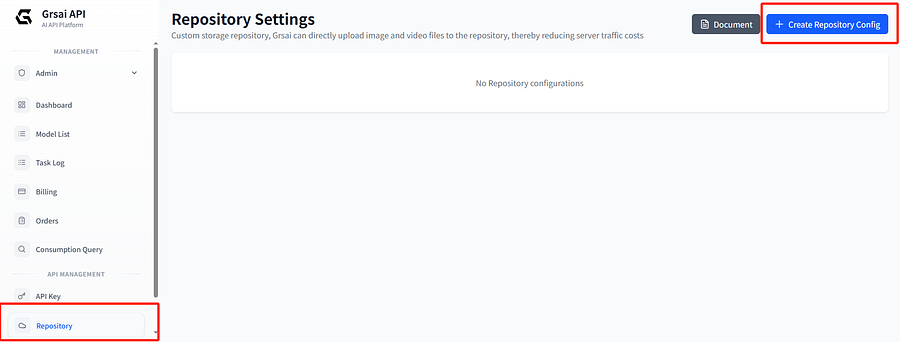
In addition to basic generation, we conducted specialized testing on GrsAI’s enterprise-level feature — custom storage library. This feature allows developers to upload videos, images, and other materials directly to the platform-hosted storage space, reducing hidden costs and improving workflow efficiency.
1.Core Mechanism and Cost Savings
In conventional workflows, developers need to build their own object storage services, which means: additional purchase of cloud storage, management of access permissions, and bearing traffic costs for materials transferring multiple times between “user server → cloud storage → AI model”. GrsAI’s storage library greatly simplifies this chain, directly referencing the returned links from the storage library without needing to transit through your own server again.
2.Actual Test Effect
We simulated a batch task of “generating 100 product videos and selecting 20 of them for stylized secondary creation”. After using the storage library, file transfer alone is expected to save about 70% of intermediate traffic costs.
Functional Completeness:
One of GrsAI’s core advantages is providing complete Sora2 native advanced function interfaces, allowing developers to directly call the official’s most core creation capabilities, mainly including the following three:
1.Role Creation (Cameo)
Allows you to upload a non-human character role to the platform, generating a dedicated, reusable digital role. Then in any new video generation, just @ the role in the prompt to stably have it appear in new scenes, ensuring brand image consistency across different videos.
2.Video Remixing (Remix)
This feature can remix videos on the Sora2 platform by modifying prompts to change content.
3.Create New Role from AI Video
You can take any Sora2-generated video, capture a few seconds of excellent role performance, and “extract” it to create a reusable role.
Global Service Capability:
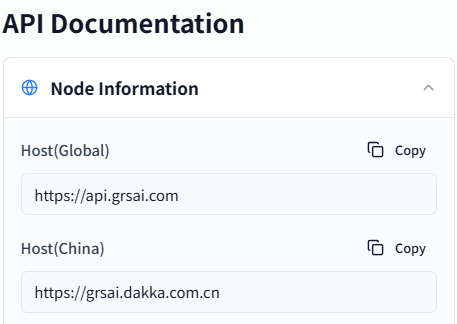
Domestic and international direct connection interfaces selectable based on needs
- Call via domestic direct connection domain (grsai.dakka.com.cn), average latency below 50ms, smooth experience.
- Call via international interface (api.grsai.com) from overseas nodes, average latency about 150ms, far better than directly accessing source services from overseas.
- During the entire test cycle, services in both regions maintained 100% availability.
This capability is crucial for development teams distributed across countries or products targeting global users. It ensures that no matter where developers are, they can get consistent, low-latency stable service, eliminating common troubles of cross-border network access.
III. Sora2 API Access Tutorial
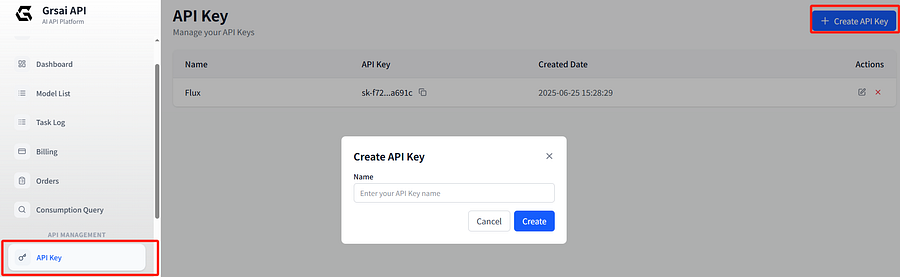
- Visit GrsAi Api console(https://grsai.com/dashboard/api-keys)
- Create API Key and save
- View online experience/documentation for access preparation
Sora2 Documentation: https://grsai.com/dashboard/documents/sora-2
1.Environment Preparation
All requests need to add authentication information in Header:
{
  "Content-Type": "application/json",
  "Authorization": "Bearer apikey"  // Replace with actual API key
}
2.Basic Video Generation Example
// The simplest video generation request
const response = await fetch('https://grsai.dakka.com.cn/v1/video/sora-video', {
    method: 'POST',
    headers: {
        'Content-Type': 'application/json',
        'Authorization': 'Bearer your_api_key'
    },
    body: JSON.stringify({
        model: 'sora-2',
        prompt: 'A cute cat playing on the grass',
        aspectRatio: '16:9',
        duration: 10
    })
});
IV. Core New Function Access Tutorials
Function 1: Role Upload Interface
Introduction: This is the key interface for Sora2 model’s native Cameo (role cameo) capability. Enterprises or developers can upload prepared, compliant non-real-person role video clips (such as brand mascots, cartoon images, 3D model animations, etc.) to the platform. Roles created through this interface can be stably called in all subsequent video generation tasks, ensuring role image and action style absolute consistency across different videos and scenes.

Interface Address
POST /v1/video/sora-upload-characterCore Parameters Explanation
{
    "url": "Role video URL or Base64 encoding",
    "timestamps": "0,3",
    "webHook": "Optional callback address"
}
Practical Call Example
// Upload role video clip
const uploadCharacter = async (videoUrl, startTime, endTime) => {
    const response = await fetch('https://grsai.dakka.com.cn/v1/video/sora-upload-character', {
        method: 'POST',
        headers: {
            'Content-Type': 'application/json',
            'Authorization': 'Bearer your_api_key'
        },
        body: JSON.stringify({
            url: videoUrl,
            timestamps: `${startTime},${endTime}`,  // For example: start seconds, end seconds e.g. "0,3" means first 3 seconds
            webHook: "-1"  // Immediately return task ID
        })
    });

    const result = await response.json();
    if (result.code === 0) {
        console.log('Role upload successful, ID:', result.data.id);
        return result.data.id;
    }
    return null;
};
// Usage example
const characterId = await uploadCharacter(
    'https://your-domain.com/character-video.mp4',
    0,
    3);
Key Points:
- Video Requirements: Supports up to 3-second role clips, cannot upload real-person videos
- Return Result: Success returns character_id, format character.name
- Usage: Uploaded roles will be automatically referenced, no extra operation needed in video generation
- Failure Reasons: “output_moderation”: output violation, “input_moderation”: input violation, “error”: other errors. No matter the issue, failures instantly refund credits
Function 2: Create Role from Original Video
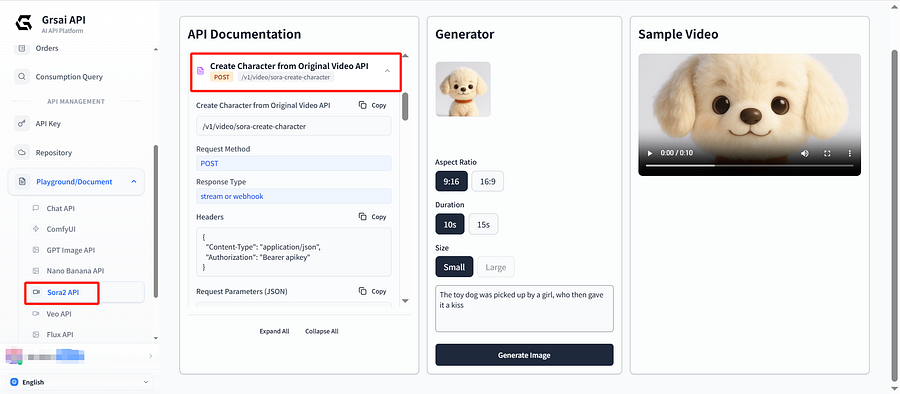
Introduction: This interface directly connects to Sora2 model’s role understanding and reuse capability. It allows developers to directly capture and “extract” excellent role clips from any Sora2-generated video, one-click creating a new, independent reusable role. This completely opens the closed loop of “AI native creation — asset mining — continuous reuse”, making every successful video generation precipitate assets for future creation.
Interface Address
POST /v1/video/sora-create-characterCore Parameters Explanation
{
    "pid": "s_xxxxxxxxxxxxxxx",  // Original video ID
    "timestamps": "0,3",  // Time range
    "webHook": "Optional callback address"
}
Practical Call Example
// Extract role from existing video
const createCharacterFromVideo = async (videoPid, startTime, endTime) => {
    const response = await fetch('https://grsai.dakka.com.cn/v1/video/sora-create-character', {
        method: 'POST',
        headers: {
            'Content-Type': 'application/json',
            'Authorization': 'Bearer your_api_key'
        },
        body: JSON.stringify({
            pid: videoPid,  // For example: s_6916910fc8548191aa07e106e84b3bb8
            timestamps: `${startTime},${endTime}`,
            webHook: "https://your-domain.com/webhook"  // Use webhook callback
        })
    });

    // If using webhook, immediately returns task ID
    const result = await response.json();
    return result.data.id;
};

// Usage example
const taskId = await createCharacterFromVideo(
    's_6916910fc8548191aa07e106e84b3bb8',
    5,
    8);
Webhook Callback Handling Example
// Server-side webhook handler
app.post('/webhook', async (req, res) => {
    const { id, results, progress, status } = req.body;

    if (status === 'succeeded') {
        const characterId = results[0].character_id;
        console.log(`Role creation successful: ${characterId}`);
        // Save role ID to database
        await saveCharacterToDB(characterId);
    }

    res.json({ received: true });
});
Function 3: Video Remix (Secondary Creation) Interface
Introduction: This interface calls Sora2 model’s video remix capability. Developers can provide an existing Sora-generated video (identified by unique pid), and give a new prompt, the model will creatively rewrite based on the original video’s visual style, roles, and composition, generating a video that retains the original essence but presents new plot or style. This is the core interface for video style transfer, plot continuation, and multi-version ad generation.
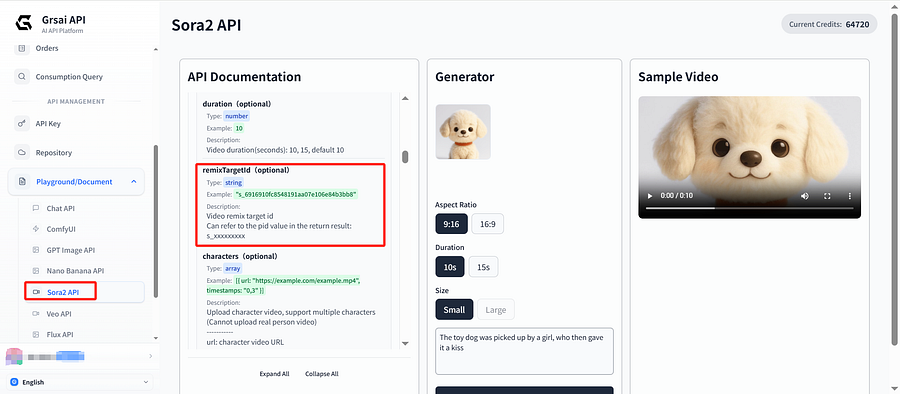
Call Example Code
The following code demonstrates how to remix a generated video via GrsAI API for secondary creation.
// Configuration information
const API_KEY = 'YOUR_GRSAI_API_KEY';  // Replace with your GrsAi.com API Key
const BASE_URL = 'https://api.grsai.com/v1';  // Or use domestic node https://grsai.dakka.com.cn/v1
const headers = {
    'Content-Type': 'application/json',
    'Authorization': `Bearer ${API_KEY}`
};

// 1. Prepare Remix request parameters
const remixPayload = {
    model: 'sora-2',
    prompt: 'Convert the scene to cyberpunk nighttime city, neon lights flashing, light rain falling.',  // New creative instruction
    remixTargetId: 's_6916910fc8548191aa07e106e84b3bb8',  // Core parameter: fill in original video's PID
    aspectRatio: '16:9',
    duration: 10,
    webHook: 'https://your-server.com/webhook'  // Optional: strongly recommend using Webhook to receive results
};
// 2. Initiate Remix generation request (async function example)
async function createRemixVideo() {
    try {
        const response = await fetch(`${BASE_URL}/video/sora-video`, {
            method: 'POST',
            headers: headers,
            body: JSON.stringify(remixPayload)
        });
        if (!response.ok) {
            throw new Error(`HTTP error! status: ${response.status}`);
        }
        const taskData = await response.json();
        const taskId = taskData.id;
        console.log(' Remix task submitted successfully! Task ID:', taskId);
        // 3. Start polling task status (if not using webHook)
        if (!remixPayload.webHook || remixPayload.webHook === '-1') {
            pollTaskStatus(taskId);
        } else {
            console.log(' Please wait for Webhook callback. Configured callback address:', remixPayload.webHook);
        }
    } catch (error) {
        console.error(' API request failed:', error);
    }
}
// 4. Function to poll task status
async function pollTaskStatus(taskId) {
    const pollInterval = 5000;  // Poll every 5 seconds
    const poll = async () => {
        try {
            const statusResponse = await fetch(`${BASE_URL}/video/tasks/${taskId}`, {
                method: 'GET',
                headers: headers
            });
            if (!statusResponse.ok) {
                throw new Error(`Status query failed, status code: ${statusResponse.status}`);
            }
            const statusData = await statusResponse.json();
            const currentStatus = statusData.status;
            console.log(`Current polling status: ${currentStatus}`);
            if (currentStatus === 'succeeded') {
                const videoUrl = statusData.results?.[0]?.url;
                console.log('Remix video generated successfully!\nDownload link:', videoUrl);
                // Can trigger subsequent operations here, like updating UI or downloading video
                return true;  // End polling
            } else if (currentStatus === 'failed') {
                console.error('Generation failed, error info:', statusData.error || 'Unknown error');
                return true;  // End polling
            }
            // If status is 'pending' or 'running', continue polling
            return false;
        } catch (error) {
            console.error('Error during polling:', error);
            return false;  // Can choose to continue or stop on error
        }
    };
    // Set up polling
    const pollLoop = async () => {
        const isFinished = await poll();
        if (!isFinished) {
            setTimeout(pollLoop, pollInterval);  // Continue next poll after interval
        }
    };
    console.log('Starting to poll Remix task status...');
    pollLoop();
}
// Execute function
createRemixVideo();
Notes:
- Core Parameter remixTargetId: This is the key for Remix function, must fill in the source video’s unique identifier pid (format usually s_xxxxxxxxxxxxxxx). This pid can be obtained from the success response of the first video generation.
- Workflow: API uses asynchronous task mode. After submitting request, immediately returns a task ID, developers need to poll via this ID or configure Webhook to get final generation result (video URL).
V. Advanced Application: Multi-Role Video Generation Practical
// 1. First upload multiple roles
const character1 = await uploadCharacter(url1, 0, 3);
const character2 = await uploadCharacter(url2, 0, 3);
// 2. Reference specific roles in prompt
const generateVideoWithCharacters = async () => {
    const response = await fetch('https://grsai.dakka.com.cn/v1/video/sora-video', {
        method: 'POST',
        headers: {
            'Content-Type': 'application/json',
            'Authorization': 'Bearer your_api_key'
        },
        body: JSON.stringify({
            model: 'sora-2',
            prompt: '@character1 is talking with @character2 in a park',  // Reference roles
            aspectRatio: '16:9',
            duration: 15,
            characters: [
                {
                    url: "https://example.com/character1.mp4",
                    timestamps: "0,3"
                },
                {
                    url: "https://example.com/character2.mp4",
                    timestamps: "0,3"
                }
            ]
        })
    });
    return await response.json();
};
Role Reference Rules:
- Automatic Reference: Uploaded roles will be automatically applied to subsequent video generations
- Precise Control: Use @character1, @character2 to specify which role
- Position Correspondence: @character1 corresponds to the first element in characters array
VI. Summary
GrsAI has enterprise-level service stability, with low prices while ensuring high success rates and global availability, making it capable of supporting large commercial projects. Not only provides Sora2 access channel, as a comprehensive AI API aggregation platform, it also provides unified call entrances for multiple mainstream models like Nano Banana flase (image generation), Nano Banana Pro, GPT-4o, Veo3.0/Veo3.1 (video generation), Gemini 3 (text generation). This provides great convenience for developers building complex multi-modal AIGC workflows, avoiding switching and managing keys across multiple platforms.


评论
发表评论